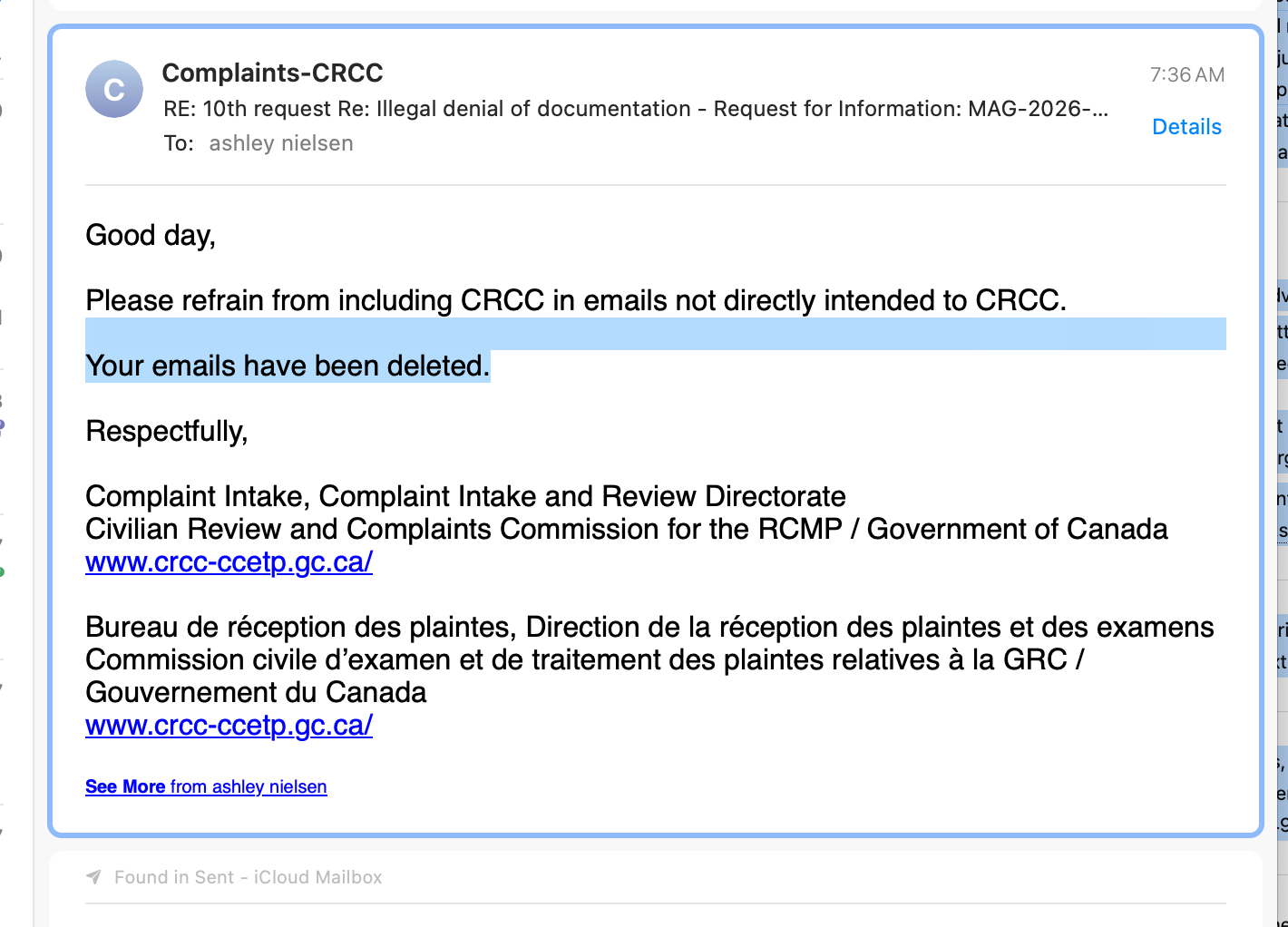
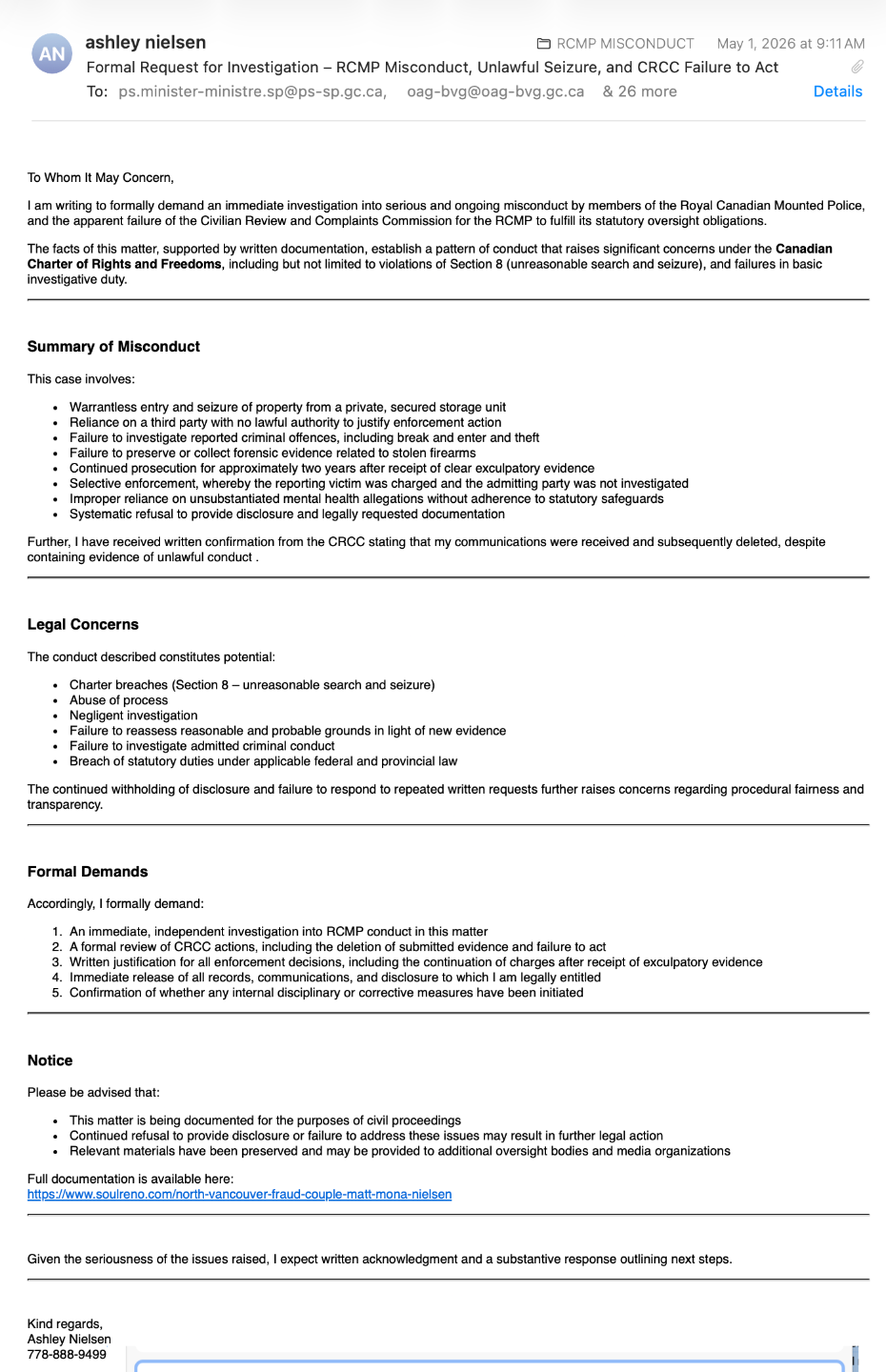
CRCC Admits Deleting Evidence In RCMP Misconduct Case
RCMP OFFICERS:
Constable Brian Simmons
Constable Dave Dundas
Cpl. Nicholas Wunderlich (Serious Crime Unit)
ARE YOU A VICTIM?
HAVE YOU BEEN A VICTIM OF RCMP MISCONDUCT OR SYSTEMATIC ABUSE INVOLVING ANY OF THESE OFFICERS?
IF YES, CONTACT: 778.888.9499
CRCC Submission
Formal Complaint Regarding RCMP Conduct
Complainant: Ashley X Nielsen
Date of Birth: XXXXX
RCMP File Numbers:Wellness checks / Purposeful Emotional Duress:
NV 2023-7591
NV 2023-19360
Illegally entering my home and transferring the keys to a third party:
NV 2023- 21300
Firearms report:
2024-1833
Crown Case:
71303-1 Police File: 24-1833
After Crown Case:
Request for charges - Denied as of September 30th, 2025
NV 25-20415
Detachment: North Vancouver RCMP
Time Period of Events: 2022 - 2026 (present day)
Overview
This complaint concerns a pattern of investigative misconduct, unlawful search and seizure, failure to investigate reported criminal offences, improper reliance on false mental health allegations, and continuation of prosecution after receipt of exculpatory evidence.
The conduct described below resulted in:
Warrantless seizure of lawfully owned firearms from a private storage unit
Failure to investigate a reported break and enter
Failure to properly record and investigate stolen firearms
Failure to investigate reported financial exploitation and fraud
Charges laid and pursued for approximately two years despite exculpatory evidence
This complaint is directed at RCMP conduct, decision-making, and adherence to statutory and constitutional obligations.
II. Background Timeline (Summary)
1. False Wellness Check
First Visit:RCMP attended my private residence in response to a wellness report made by [accuser - Matt/Mona Nielsen].
Officers assessed the situation and took no action.
Second Visit: RCMP attended the residence of Matt and Mona Nielsen in response to a wellness report made by [accuser - Matt/Mona Nielsen].
Officers assessed the situation and took no action.
Officer Dundas:
An attending officer verbally acknowledged observable coercion yet did not investigate or document it.
Officer stated: “Your parents are controlling everything, aren’t they?”
Officer recognized potential coercion.
Officer recognized imbalance.
Officer took no protective action.
Officer did not investigate exploitation.
At that time:
I was fully competent and independent.
No apprehension under the Mental Health Act occurred.
No Form 4 or medical documentation existed.
No statutory criteria for apprehension were met.
2. Firearms Removed Without Consent
Unknown to RCMP at the time of the wellness check, the accuser had:
Entered my private residence without authorization.
Removed my registered firearms.
Refused to return them when requested.
At time of Break and Enter I was out of the country.
3. Report of Stolen Firearms
October 2023 - I reported the firearms as stolen to RCMP IN WRITING*.
RCMP did not file a missing firearms report for over 3 months despite repeated follow-ups(in writing). Only after persistent contact was a report formally created.
Reported missing by registered firearms owner - October 2023 - Ignored**
RCMP did not investigate until February 1, 2024, the following calendar year.
4. Investigation and Storage Unit Seizure
After finally acknowledging the firearms as missing, RCMP attended the accuser’s residence. The accuser claimed the firearms were inside my private storage locker.
RCMP then attended my storage facility without a warrant and seized the firearms with the accuser who had broken and entered into my private residence to steal the firearms orginally.
5. Court Date Set
RCMP registered a court date AGAINST* me in relation to firearms and mental health concerns. Without* proving any cause/ evidence or documentation.
They showed no cause.
6. Exculpatory Evidence Emerges
After court date was set, the accuser (Matt Nielsen) provided a written statement to the Crown AND the RCMP admitting:
They illegally removed the firearms from my residence.
They illegally attended my storage locker on multiple occasions while I was out of the country.
They illegally attempted to access it but their key did not fit.
The storage company confirmed:
The accuser attempted to illegally gain access.
The accuser attempted illegally to pay rent for access to the locker as documented by the storage company in writing.
The accuser had no lawful access rights.
Despite this evidence, prosecution continued for approximately two years before charges were withdrawn days shortly before trial.
III. Specific Allegations
1. Unlawful Search and Seizure (Section 8 – Charter)
The firearms were seized from a privately rented storage unit.
At the time of seizure:
The rental agreement was solely in my name.
The lock had been changed.
The accuser had no legal, contractual, or possessory rights.I was outside Canada.
No exigent circumstances existed.
RCMP:
Attended without a warrant.
Brought a locksmith despite lacking warrant.
Claimed the unit was “unlocked” but produced no evidentiary proof.
Seized property from a private secured facility behind an electric gate with surveillance.
RCMP attended with a locksmith yet later reported the unit was unlocked. No evidentiary documentation was provided to support that claim.
A private storage unit carries a reasonable expectation of privacy under Section 8 of the Charter.
There was no lawful third-party consent.
There was no exigent circumstance.
There was no judicial authorization.This constitutes an unreasonable search and seizure.
2. Unlawful Reliance on a Third Party With No Legal Authority
At the time of the seizure:
The storage locker was solely rented in my name.
The rental agreement was exclusively in my name.
The lock had been changed.
The accuser had no key that functioned.
The accuser had no contractual relationship with the storage facility.
The accuser had no legal ownership or possessory interest in the locker.
The accuser had no lawful authority over my firearms.
The storage facility later confirmed in writing that:
The accuser had attended the premises on multiple occasions.
The accuser attempted to pay the unit’s rent to obtain access.
The accuser was denied access because they were not the registered renter.
The accuser’s own written statement admits:
They removed the firearms from my private residence without permission.
They later attended the storage facility.
They were unable to access the locker because their key did not fit 24 hours before the rcmp seizure- indicating there was a LOCKED LOCK on the storage unit which.
Despite this, RCMP members:
Attended the storage facility without a warrant.
Brought a locksmith with them despite lacking judicial authorization.
Entered and seized property from a private storage unit.
Claimed the unit was “unlocked” yet produced no evidentiary record (photo, video, or third-party confirmation) to substantiate this claim.
Even if the unit had been unlocked (which is disputed), lawful authority to enter and seize property from a private rented space still requires legal justification.
The accuser possessed no authority that could legally override my Charter-protected privacy interest in that space.
Under Section 8 of the Charter, warrantless entry into a private storage unit absent exigent circumstances constitutes an unreasonable search and seizure.
This was not a case of mistaken authority.
This was a complete absence of authority.The storage facility confirmed in writing that the accuser was denied access.
Despite this, RCMP relied on information from an individual who had no legal authority over the premises.
This reflects a failure to verify lawful consent prior to entering private property.
RCMP were aware I was outside Canada during key periods yet continued to frame enforcement as an active safety concern.
I was living out of country:
At time of break and enter
At time of alleged risk
During locker access period
3. Failure to Properly Investigate Reported Break and Enter
I reported that:
My residence had been unlawfully entered.
My registered firearms had been removed without consent.
The identified individual refused to return them.
RCMP:
Delayed filing a missing firearms report for over two months.
Did not pursue break and enter investigation.
Did not lay charges for the unlawful removal.
Did not secure forensic evidence from the residence.
The accuser later admitted in writing to removing the firearms.
RCMP failed to investigate the criminal conduct I reported.
4. Failure to Preserve and Collect Forensic Evidence
The firearms were missing for months.
RCMP:
Did not fingerprint the firearms.
Did not test for forensic handling.
Did not establish proper evidentiary continuity documentation.
Did not preserve potential evidence regarding who handled the firearms.
No forensic testing was conducted despite the firearms being reported stolen and in unauthorized possession for several months. (negligent)
This was a significant failure, particularly given that stolen firearms present serious public safety concerns.
5. Failure to Investigate Reported Financial Exploitation
I provided RCMP with:
Property title documents.
Trust documentation.
Evidence that my name was used in real estate transactions.
Evidence that funds were controlled and signed by the trustee without authorization.
Evidence of profit retained by the trustee without disbursement since 1993.
Evidence via lawyer demand letters that the accusor refused to release my banking documentation for trust and any or all real estate transactions done in my name.
If RCMP genuinely believed I was mentally vulnerable, they had heightened duty to investigate potential financial exploitation.
RCMP did not:
Initiate a fraud investigation.
Interview relevant financial institutions.
Seek documentary production.
Investigate unauthorized signatures and signatures forced through duress.
Instead, they continued to treat me as the subject of concern rather than the victim of exploitation.
6. Misuse of Mental Health Allegations
No formal psychiatric diagnosis existed.
No Mental Health Act apprehension occurred.
No statutory criteria were met.
No Form 4 was issued.Despite this:
Mental health was cited as justification for enforcement action.
Charges were pursued based on mental health risk assertions.
No statutory procedure under the British Columbia Mental Health Act was followed.
All without showing any cause.
If police rely on mental health authority, they must follow statutory safeguards.
Those safeguards were not followed.
7. Negligent Investigation
The investigative pattern demonstrates:
Failure to timely document reported stolen firearms.
Failure to investigate break and enter.
Failure to verify lawful authority prior to search.
Failure to preserve forensic evidence.
Failure to investigate financial exploitation.
Reliance on an individual later admitting unlawful conduct.
The investigation appears to have been directed against the reporting victim rather than the admitting perpetrator.
8. Continuation of Charges After Exculpatory Evidence
After receipt of:
A written admission from the accuser,
Storage facility confirmation of unauthorized access attempts,
Evidence I was outside Canada during key events,
Charges were not withdrawn.
Prosecution continued for approximately two years.
This raises serious concerns regarding:
Reasonable and probable grounds.
Ongoing investigative objectivity.
Disclosure and internal review processes.
After receiving written admission that firearms were removed by another party, RCMP did not recommend charges against that party and did not document reassessment of reasonable and probable grounds.
IV. Requested Findings
I respectfully request that the CRCC investigate and make findings regarding:
Whether RCMP conducted an unlawful search and seizure.
Whether RCMP improperly relied on an individual with no lawful authority.
Whether RCMP failed to properly investigate reported criminal offences.
Whether RCMP failed to preserve and collect forensic evidence.
Whether RCMP improperly relied on unsubstantiated mental health claims.
Whether investigative conduct met the standard required of a reasonable police officer.
Whether continuation of charges after receipt of exculpatory evidence was appropriate.
9. Failure to Investigate and Consider Charges Against the Admitting Party
Following the initiation of charges against me, the accuser:
Provided false statements that triggered RCMP involvement.
Later provided a written statement admitting to removing my registered firearms from my locked private residence without my consent.
Admitted attending my private storage facility multiple times.
Attempted to gain access to a storage locker to which they had no legal authority.
The storage facility independently confirmed that:
The accuser attempted to access the locker.
The accuser attempted to assume payment to gain control.
The accuser was not authorized to access the unit.
Despite receiving a written admission that firearms were removed from a locked private residence without consent, RCMP did not:
Lay or recommend charges for Break and Enter.
Lay or recommend charges for Theft.
Investigate unlawful possession.
Investigate unlawful transportation of firearms.
Investigate potential public safety violations.
The firearms were removed from a locked private dwelling and transported without my knowledge or consent.
If no lawful authorization or transport permit existed, the removal and relocation of restricted or regulated firearms may have engaged offences under the Criminal Code and the Firearms Act.
RCMP chose not to pursue any enforcement action against the admitting individual.
Selective Enforcement and Investigative Imbalance
This creates a clear investigative asymmetry:
The reporting victim was charged.
The admitting individual was not charged.
False initial statements that triggered police involvement were not investigated.
An admitted unauthorized removal of firearms from a locked dwelling was not prosecuted.
The refusal to investigate or lay charges following an admission of unlawful removal raises concerns regarding:
Investigative neutrality.
Equal application of the law.
Failure to assess reasonable and probable grounds once new evidence was obtained.
False Statements and Public Mischief
The initial wellness report and subsequent statements materially triggered police action and enforcement consequences.
If those statements were knowingly false, they may have engaged offences relating to public mischief or obstruction.
RCMP did not investigate the truthfulness of those initial claims despite later admissions contradicting the narrative that had formed the basis of enforcement action against me.
Public Safety Considerations
Registered firearms were:
Removed from a lawful owner without consent.
Unlawfully possessed for a period of months.
Transported without documented authorization or transport permit.
Stored without the owner’s knowledge.
These facts raise significant public safety concerns. Since the RCMP did not fingerprint nor do any forensic testing - they have caused a serious issue if those firearms were every used while stolen.
The decision not to investigate or pursue charges in these circumstances requires review.
10. Improper Reliance on Mental Health Allegations and Failure to Follow the Mental Health Act (British Columbia)
A. Statutory Threshold Under the Mental Health Act
Under the BC Mental Health Act, a peace officer may apprehend a person without a warrant only if the officer has reasonable grounds to believe that:
The person is acting in a manner likely to endanger their own safety or the safety of others;
The person is apparently suffering from a mental disorder; and
The person requires examination by a physician.
All three elements must be present.
In my case:
I was not acting in a manner endangering myself or others.
No physician had diagnosed me with a mental disorder.
No Form 4 was issued.
I was not apprehended under the Act.
No medical examination under statutory authority occurred.
Despite this, mental health concerns were used as justification for enforcement action and firearms seizure.
If RCMP rely on mental health authority, statutory safeguards must be followed.
They were not.
B. Absence of Formal Mental Health Process
RCMP did not:
Obtain a warrant under the Mental Health Act.
Apprehend me under statutory authority.
Arrange a lawful psychiatric examination.
Issue or rely on any formal medical certification.
Yet “mental health” was cited as a risk basis for criminal enforcement.
Using mental health concerns as a justification while bypassing the statutory framework constitutes misuse of discretionary authority.
C. Heightened Duty Toward a Person Allegedly Under Mental Duress
If RCMP genuinely believed I was mentally vulnerable, that belief triggered an enhanced duty of care.
At the same time that RCMP were:
Acting on claims of my alleged instability
Seizing my property on that basis
Laying charges referencing safety concerns
They were provided with:
Property records showing transactions in my name
Trust documentation
Evidence of funds being controlled by another party
Evidence of real estate purchases and flips using my name
Evidence that profits were not disbursed to me.
If police believe a person is mentally vulnerable and are presented with credible documentation suggesting financial exploitation, they have a duty to assess whether that person is a victim of fraud.
Instead:
No fraud investigation was initiated.
No financial crime unit was engaged.
No referral was made to federal anti-fraud authorities.
No inquiry was made regarding unauthorized signatures.
No protective steps were taken.
If I was competent, the mental health justification collapses.
If I was vulnerable, the failure to investigate exploitation becomes more serious.Under either scenario, the investigative response was inconsistent.
D. Failure to Investigate Alleged Identity and Financial Fraud
I provided documentation showing:
Use of my name in real estate transactions.
Trustee control over funds.
Profits retained by another party.
Refusal to release trust accounting.
Refusal to release real estate documentation for purchased and sold properties in my name.
Despite this, RCMP did not:
Open a fraud file.
Did not check land titles to verify properties purchased and registered/associated tax fraud of property taxes not being paid - in my name by the Nielsen’s.
Interview financial institutions.
Seek records.
Refer the matter to appropriate fraud authorities.
Report suspected identity misuse.
If RCMP believed the allegations of my instability, and simultaneously held documentation showing possible exploitation, failure to investigate contradicts their asserted concern for public safety.
They failed to assess credible evidence of financial exploitation.
They failed to open a fraud investigation despite documentation provided from the land titles office, as well as legal letters from the trust attorney requesting banking documents for my trust fund (Legacy Law).
They acted inconsistently with their own stated belief that I was vulnerable.
E. Inconsistent Risk Assessment
RCMP actions reflect inconsistency:
I was considered sufficiently unstable to justify seizure and charges.
I was not considered sufficiently vulnerable to justify protection from alleged financial exploitation.
I was prosecuted while the admitting party was not investigated.
This inconsistency requires review of:
Whether mental health concerns were objectively assessed,
Whether they were independently verified,
Whether they were used selectively to justify enforcement.
F. Requested Review
I request that CRCC examine:
Whether statutory criteria under the Mental Health Act were met.
Whether mental health authority was properly invoked.
Whether mental health allegations were independently verified.
Whether RCMP had a duty to investigate potential financial exploitation.
Whether investigative discretion was exercised neutrally.
Whether mental health claims were used in lieu of proper statutory procedure.
Requested Review
I request that CRCC review:
Whether RCMP properly assessed reasonable and probable grounds regarding break and enter.
Whether RCMP properly assessed theft and unlawful possession.
Whether RCMP properly considered firearms transportation offences.
Whether RCMP applied enforcement discretion in a neutral and even-handed manner.
Whether false reporting was appropriately investigated.
V. Supporting Documentation
Storage facility written statement
Accuser written admission
Rental agreement
Travel records
Firearms registration
Correspondence with RCMP
Trust and property documents
Court withdrawal documentation
Emails with real estate lawyers notifying them that I was being forced to sign contracts against my will in the dark when pressured by a group of 2 when repetitive visits were made in the dark to force signing under duress and threats.
Demand letters from trust attorney.
Format Requested
I request:
Electronic copies (PDF format)
Email chains in native format where available
All attachments included with original communications
If any records are withheld, please specify the section of FIPPA relied upon.
Kind regards,Ashley Nielsen778.888.9499