Simulated: The Hidden Code Behind Reality, Perception, and You
Nov 07, 2026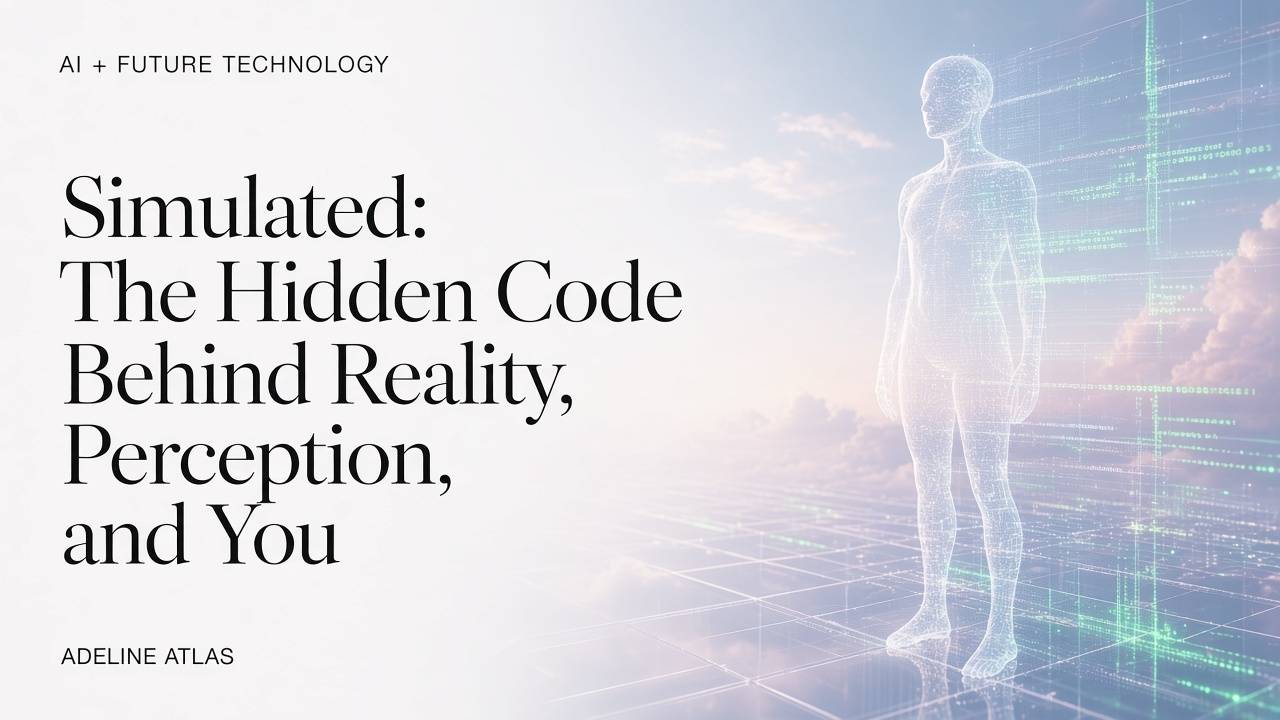
The question isn't new: are we living in a simulation?
Most people hear that and assume it's a thought experiment, a fringe theory, or a late-night joke. But the simulation question has moved well beyond idle speculation. Philosophers argue about it in academic journals, physicists debate whether the universe is fundamentally made of information, and anyone paying close attention to how modern life behaves has felt the strange sense that something about reality is more responsive than we were taught.
This series starts with a clear premise: reality behaves like a simulation because it is one. That is the working hypothesis of everything that follows — a bold philosophical position, not a settled scientific finding, and one worth following all the way through to see what it reveals.
Not a Video Game — a Rendered Interface
When people picture "simulation," they often imagine the cartoon version: a person trapped inside a video game, or a body floating in a pod while machines feed it a fake world. That is not what this series means.
The simulation idea explored here is functional. It describes a world in which what you perceive is being generated, filtered, and updated in response to input. And that input isn't only external. It includes you. Your attention, your assumptions, your language, and your beliefs all act like variables in the system. Change those, and the output you experience changes with them.
Part of this is well established. Cognitive science has shown for decades that perception is constructive: the brain doesn't passively record the world, it builds a model of it from fragments of sensory data, memory, and expectation. Information theory and modern physics have pushed many thinkers to ask whether information, rather than solid matter, is the deepest layer of reality. Other parts of this framework are philosophical and speculative — a lens rather than a lab result. Throughout the series, the goal is to keep both in view.
Taken together, the logic is simple: what you see, feel, and experience is not a direct feed from the outside world. It is a rendered interface.
Part One: The Architecture of the Simulation
The series is divided into two parts. Part One outlines the structure of the simulation itself. It explores:
- Quantum mechanics and observer-based physics — why the smallest building blocks of nature seem to behave differently depending on whether they are measured.
- Perceptual science and filtered cognition — how your brain edits, compresses, and fills in the world you think you are seeing directly.
- Glitch phenomena, NPC behavior, and timeline shifts — the odd experiences, from déjà vu to the Mandela Effect, that many people interpret as cracks in the render.
- How all of these point toward a responsive, non-fixed system — a world that seems less like a static stage and more like an interactive environment.
This section is about recognizing the architecture: how the simulation is built, how it responds, and why your experience of life is more constructed than inherited.
Explore the AI + Future Technology Video Series
Watch the AI + Future Technology Video Series by Adeline Atlas.

Part Two: Prompt Theory, the Interface
Then we shift.
Part Two introduces Prompt Theory — the applied mechanics of how your input shapes your experience in real time. Prompt Theory proposes that the reality you experience functions like a rendered system that responds to prompt-like input. Just as an AI system returns results based on the quality and clarity of a prompt, so does your life.
That includes:
- The role of identity in determining what renders. Who you believe you are quietly decides what you notice, attempt, and accept.
- How belief systems act as operating code. Beliefs work like instructions running in the background, shaping interpretation before you are even aware of an event.
- Why emotional tone functions like voltage. Feeling adds charge — it determines what gets flagged as important and what repeats.
- How language, intention, and expectation format experience. The words you use and the outcomes you anticipate act as the formatting rules for what you live through.
Here is the important part: you don't have to believe in simulation theory to benefit from Prompt Theory. You can treat it purely as a practical model of attention and belief. But overstanding both gives you a much fuller picture of what you experience — and why certain things keep repeating.
Why It Matters Now
As this book frames it, AI has put prompting in front of everyday users, many of whom are discovering that the quality of the output depends on the quality of the input. A vague prompt gets a vague answer. A precise, well-framed prompt gets something useful.
What most people miss is the deeper parallel. Humans have always been prompting. We've simply been doing it unconsciously — through the stories we tell about ourselves, through bias, through emotional state, through what we expect to happen. AI is unintentionally showing us how our own system works.
The punchline is simple: the machine we built to mirror us is now teaching us how we've always operated.
Two Lenses, One Manual
Think of the two halves of this series as two lenses on the same experience:
- Simulation Theory explains the system — what reality might be, how it might be built, and why it behaves the way it does.
- Prompt Theory explains the interface — how you interact with that system and how your input shapes your output.
Together, they form something like a manual for navigating reality as it actually functions in your lived experience, not as we were taught to assume it does.
This series is not about escaping the simulation. It's about overstanding it. Once you see how your experience is rendered — what you filter in, what you filter out, what you keep repeating — you stop simply reacting to it and start formatting it with intention.
Let's begin.
Watch the Series
If this way of looking at reality speaks to you, Watch the AI Future Tech Series.