Parallel Dimensions and Portal Perception: Is Consciousness a Dimensional Selector?
Nov 07, 2026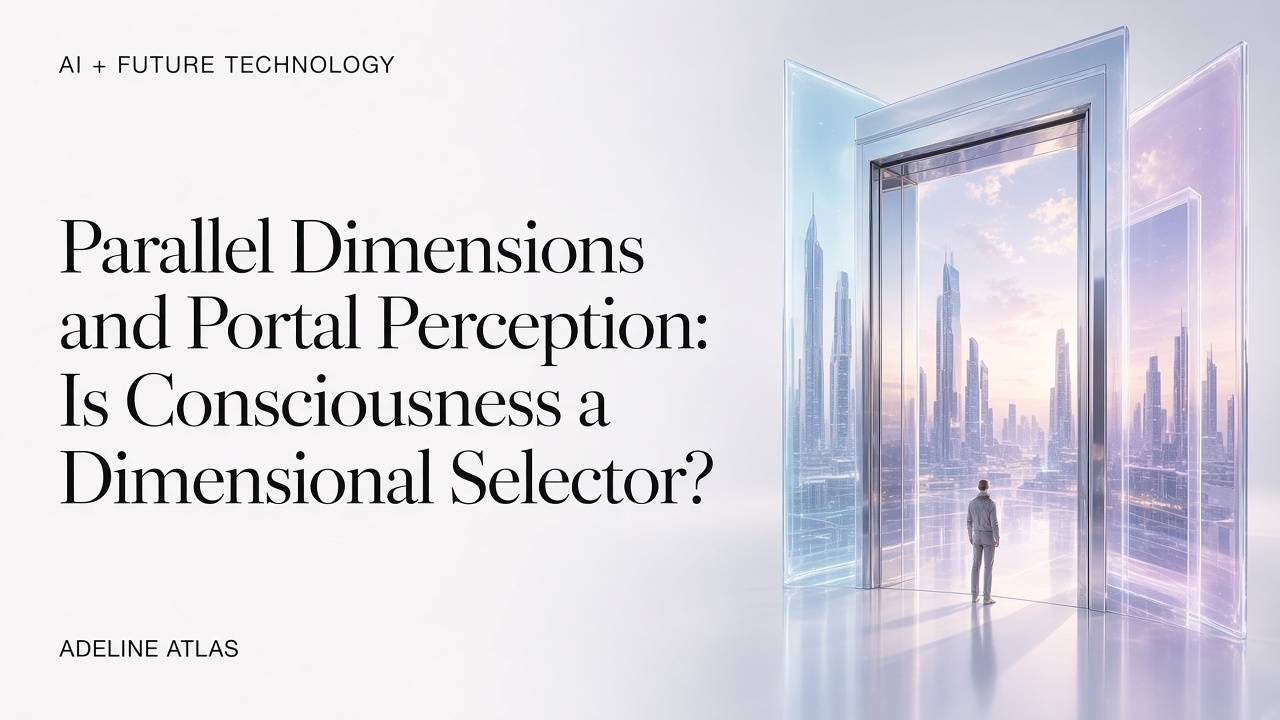
Perception may render not only this version of reality, but potentially one of many. Simulation theory challenges the assumption that there is one single, stable world. Instead, it suggests that what we call "reality" may be a selectable outcome within a multidimensional interface.
This post explores the scientific theories, neurological experiences, and lived anomalies that make parallel dimensions feel plausible — and how human perception might serve as the access key. Along the way, it's worth being clear about what is established physics, what is mathematical theory, and what is a simulation-based interpretation.
Multiverse Science: The Theoretical Basis for Parallel Realities
The idea of parallel worlds isn't only science fiction. It appears in serious physics.
The many-worlds interpretation. In the 1950s, physicist Hugh Everett III proposed a radical reading of quantum mechanics. Rather than a quantum event "collapsing" into one outcome, every possible outcome occurs — each in its own branch of reality. From this framework, reality is not singular but layered, with every quantum measurement creating new branches. Many-worlds is one of several competing interpretations of quantum mechanics; physicists still debate which, if any, is correct.
String theory and extra dimensions. String theory, popularized by physicists like Brian Greene, attempts to unify quantum mechanics with gravity by proposing that all particles are tiny vibrating strings. The mathematics requires additional spatial dimensions — ten or eleven in total — suggesting that our visible universe may be only a limited slice of a much larger structure.
M-theory and branes. M-theory expands on this by introducing "branes" — multidimensional surfaces that could contain entire universes. Our universe may be one such brane, floating alongside others in a higher-dimensional space.
Some versions of brane cosmology suggest these neighboring universes could occasionally interact. None of this has been experimentally confirmed. But viewed through a simulation lens, such interactions would resemble overlapping instances, timeline merges, or data exchanges between systems. That shifts the question from "Do parallel realities exist?" to "What interface governs access between them?"
Portal Perception: Cognitive Access to Alternate Renderings
If parallel versions exist, the next question becomes practical: can they be accessed?
Physics offers one theoretical mechanism in Einstein-Rosen bridges, better known as wormholes — hypothetical tunnels connecting distant points in space-time. They appear in the equations of general relativity but remain unproven. They give us a spatial model for imagining dimensional transit.
Simulation theory, however, reframes access as perceptual, not mechanical. You don't need a tunnel through space if what changes is the interface itself.
Dream states offer a clear example. In dreams, continuity dissolves. One moment you are in your childhood home, the next in a futuristic city, with no transition. Environments shift without travel. Time behaves non-linearly. Neuroscience explains dreams as the brain's own internally generated experience, but from a simulation perspective, they are fascinating: they may reflect render states with lower continuity demand, where the perceptual engine jumps between nodes without loading the transitional data in between.
Altered states show similar characteristics. People in deep meditation or psychedelic states frequently report unfamiliar architectures, unfamiliar knowledge, or non-ordinary environments. Conventional science frames these as changes in brain chemistry. The simulation framework asks whether they might also be render shifts — accessing different data structures within the system.
If perception determines rendering, then changes in awareness — through sleep, neurochemical shifts, or altered emotional states — may function like unlocking different branches. In this view they are not fictional portals. They are variations in interface access, triggered by shifts in internal state.
Explore the AI + Future Technology Video Series
Watch the AI + Future Technology Video Series by Adeline Atlas.

Simulation Clues: Mandela Effects, Scene Shifts, and Render Inconsistencies
Perceptual anomalies offer further clues that many people find hard to dismiss.
The Mandela Effect describes collective memories that contradict the current record. Classic examples include large numbers of people remembering "Berenstein Bears" when the books are spelled "Berenstain," or remembering a different number of U.S. states. Psychologists explain these as false memories shaped by expectation and suggestion. Yet many people report vivid spatial and emotional memory attached to the version they recall.
From a simulation framework, these may not be simple misremembering. They may be read as branch misalignment — memory retained from a previous simulation state that has since been overwritten. The current timeline reflects an updated render, but internal records still store data from earlier iterations.
Dream scene transitions mirror dynamic rendering. Environments load on demand, much like video game engines that render only what the player is looking at. This is consistent with simulation logic, where focus triggers visibility rather than continuous existence.
Déjà vu offers another angle. Neuroscience usually describes it as a brief mismatch in memory processing. The simulation interpretation proposes something more poetic: a momentary synchronization across simulation threads. When perceptual alignment across versions occurs, the result may be a fleeting awareness of timeline overlap — a perceptual echo from parallel threads running nearly in sync with this one.
Taken together — Mandela Effects, dream jumps, déjà vu — these experiences raise the possibility that consciousness operates across more than one version of rendered experience.
Perception as Dimensional Selector
If branching timelines exist, and if access depends on rendering mechanisms, then consciousness is more than a witness. It acts as a selector — tuning into specific outcomes based on its configuration.
Beliefs, emotional states, and attentional focus are not passive qualities. In this model, they function as parameters within the render system. What the simulation displays depends on how the observer engages with it. Perception is not merely an interpretation layer sitting on top of reality. It is a formatting tool.
That is why simulation theory positions portals not as spatial objects, but as perceptual modulations. The user — consciousness — shifts frequency and receives new output. Dimensional travel, in this sense, is not spatial relocation. It is interface reconfiguration.
Why This Matters in Everyday Life
Whether or not literal parallel universes are ever proven, this framework offers an actionable view: a change in perception results in a change in your rendered environment.
Think about how differently the same week can feel depending on your inner state. A person recovering from grief, healing an old wound, or learning to regulate their emotions often describes the world itself as having changed — new people appear, new options become visible, old triggers lose their grip. In the language of this series, healing, memory recalibration, and emotional regulation may function as interface updates, altering the branch of reality you access.
You may not need a wormhole. You may need a new configuration.
Watch the Series
To go deeper into these ideas, Watch the AI Future Tech Series.