NPCs and the Scripted Social Field: Are You Living on Autopilot?
Nov 07, 2026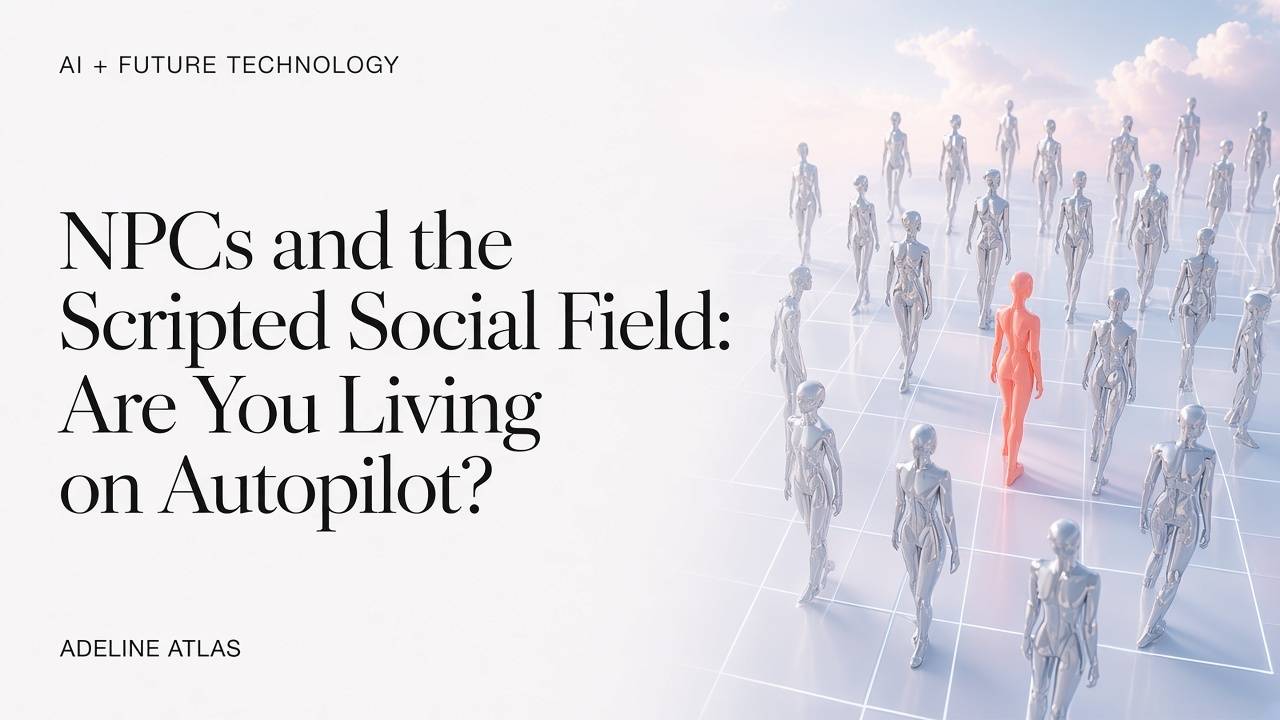
In simulation theory, not every rendered entity behaves like an autonomous agent. Some appear to follow scripts.
This post explores the non-player character (NPC) framework — a concept borrowed from game design — and what it reveals about real-world behavior, perception, and the dynamics of modern society. This isn't about labeling people. It's about recognizing patterns — including in ourselves.
Defining NPCs in a Simulation Context
In video games, NPCs are background characters. They run on preset scripts, repeat fixed lines of dialogue, and respond in predictable loops. Walk past the same shopkeeper ten times and you'll hear the same greeting ten times. Their behavior isn't random, curious, or self-directed. It's coded to keep the environment feeling continuous and alive.
The relevance to human life emerges when people begin to mirror these patterns. When actions become habitual, responses default, and perception narrows into preconfigured tracks, the result is not conscious presence. It is behavioral automation.
This does not imply a lack of intelligence or humanity. Every person has an inner life. What the NPC lens highlights is a functional shift — from adaptive participation to procedural execution. It describes a mode, not a type of person.
Society as Behavioral Script
Social systems reward predictability. Cultural norms, media narratives, institutional roles, and algorithmic feedback loops all train and reinforce consistency. The result is a population that often moves through patterned behavior without reflection or deviation.
Picture an ordinary day: wake to an alarm, scroll the news, commute, work, consume media, sleep, repeat. Language starts to mirror the headlines. Emotional reactions follow cultural consensus — outrage at the same moments, excitement at the same trends. Thoughts begin to echo group logic.
In simulation terms, this suggests a shift from active rendering to looped playback. When personal agency erodes under collective programming, behavior starts to resemble the output of a scripted asset. The difference lies not in identity, but in process.
The NPC Meme as Cultural Signal
Around 2016 and gaining wide traction in 2018, the "NPC meme" emerged online as satirical commentary on mass conformity. It began as a joke, but it spread because it struck a nerve. The image of a blank, gray figure repeating scripted lines came to symbolize a deeper concern: that much of society was running on unexamined defaults.
Social media amplifies the effect. Recommendation engines deliver a continuous stream of input, shaping beliefs without obvious coercion. The feeling of free choice remains, but the outputs — preferences, emotions, opinions — increasingly follow a narrowed, reinforced path.
This isn't literal NPC status, but it mimics the function. In simulation terms, it represents a render loop sustained by conformity rather than novelty.
Explore the AI + Future Technology Video Series
Watch the AI + Future Technology Video Series by Adeline Atlas.
Autopilot and the Brain's Default Mode
Neuroscience offers a useful parallel in the Default Mode Network (DMN) — a set of brain regions that become active when we're not focused on an external task. The DMN is associated with mind-wandering, replaying past events, imagining the future, and self-referential thinking.
The DMN is not a flaw; it's essential for reflection, memory, and imagination. But it can also keep us circling familiar internal stories — recycling the same worries, the same narratives about who we are, the same predictions about how things will go.
When that tendency is combined with constant external stimulus — news cycles, algorithmic feeds, cultural scripts — attention rarely gets space to do anything new. Internal authorship diminishes. The brain becomes more of a receiver than a creator.
This mirrors simulation logic: a system locked into rendering the same environment because it isn't receiving new variable input. The loop continues until it is interrupted by conscious redirection.
Agency vs. Procedural Consciousness
Simulation theory distinguishes between two modes of being:
- Dynamic agents interrupt patterns, introduce new variables, and render unexpected outcomes.
- Procedural actors react based on pre-coded inputs, mirroring their environment without modifying it.
Agency includes the ability to observe your own behavior, question your defaults, and act from internal alignment rather than external expectation. Procedural consciousness lacks those interventions. It runs scripts — efficient, predictable, and stable.
Crucially, these are not permanent identities. You might be fully awake and creative in your work while running on autopilot in your relationships, or vice versa. However, high-pressure systems — bureaucracies, screen-based cultures, polarized political environments — tend to push people toward the procedural end.
The cost is a systemic reduction in novelty. The simulation becomes dense with repetition. Evolution stalls. Collective intelligence stagnates.
Functional Implications in a Simulated Environment
When perception defaults to preloaded inputs, the simulation renders stability rather than discovery. This is not a moral judgment. It's a systems analysis. If most participants behave procedurally, the environment reflects their expectations back to them. Real change requires agents — people who introduce alternate parameters.
In a perceptual simulation, freedom is not inherited. It is generated. To shift the field, you first have to exit the loop. That doesn't require dramatic external rebellion. It requires internal authorship: awareness, deliberate deviation, and intentionality.
A few simple places to start noticing your own scripts:
- When was the last time you changed your mind about something important?
- Which of your opinions arrived through a feed rather than through reflection?
- What daily routine could you break, just once, to see what new input appears?
Simulation theory doesn't predict collapse from conformity. It predicts stasis — a rendered world that mirrors the past, reinforces the norm, and suppresses the unpredictable.
Novelty emerges only from the observer who sees the loop and chooses to exit it.
Watch the Series
If you're ready to look more closely at the scripts running your world, Watch the AI Future Tech Series.